
This week is a little different. I've published a book, and it's written for the people who sell bank-owned real estate, not the people who buy it.
That's exactly why you should read it.
Every bank-owned property is a small company with tenants instead of customers. It has earnings, a value, a capital cost and a clock.
Why a book for bankers
Most of the REO you'll ever buy starts as a decision inside a bank: an asset manager, a special assets officer, a credit committee. They have to put a value on the asset, pick a disposition path, and document the choice in a way an examiner and a board will accept.
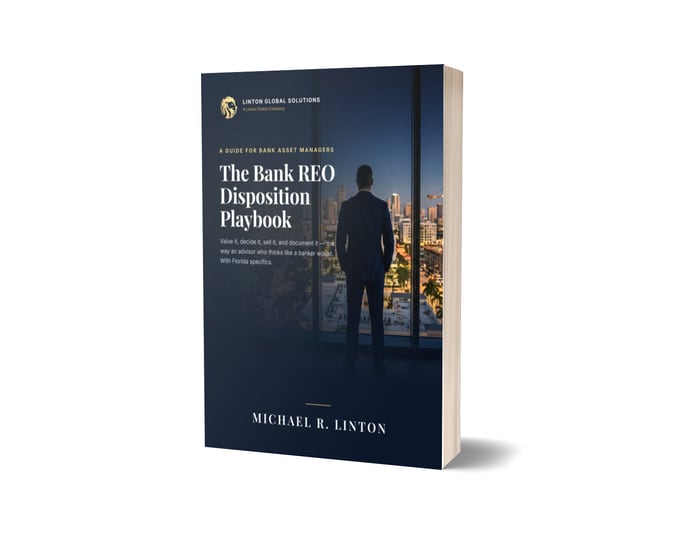
The Bank REO Disposition Playbook is my guide for that desk. It's 24 full-color pages, written to be read in one sitting, with a tear-out checklist that stays on the desk.
What's inside
- The REO lifecycle, stage by stage, with who owns each decision
- Four valuation tools (appraisal, evaluation, broker opinion, income approach) and when each fits
- A one-page comparison of listing, auction, bulk or note sale, and lease-up, on net proceeds and time
- Running the sale like an M&A process
- Florida specifics: insurance, flood, documentary stamps, condominium rules
- A worked Florida example, a cost-of-waiting table, and a tear-out checklist
What it means for buyers
If you understand how the seller decides, you write better offers. Three things from the book every REO buyer should know:
- The bank compares paths on net proceeds and time, not just price. A clean, fast, well-documented offer can beat a higher one that drags. Show proof of funds, a short diligence window, and a realistic close date.
- Carrying cost is the bank's clock. Taxes, insurance, and maintenance run every month the asset sits. Offers that shorten the clock carry more weight than most buyers realize.
- Everything gets documented. The asset manager has to justify the sale to an examiner and a board. Make that easy: put your terms and your rationale in writing so your offer reads well in their file.
Reply to Mike
One ask this week: reply and tell me which kind of bank-owned property you want to see first. Asset type, capital band, and which part of Florida. When the right asset crosses my desk, I'd rather send it to the few of you it actually fits.
And if you know an asset manager or special assets officer who'd find the book useful, forward this along.
This email comes from mike@reomind.com. Every reply hits my inbox.
— Mike
Reply directly to this email. It goes to me.

Michael R. Linton
Founder · Linton Global Solutions
Reply directly to this issue — mike@reomind.com. It goes to me, not a queue.